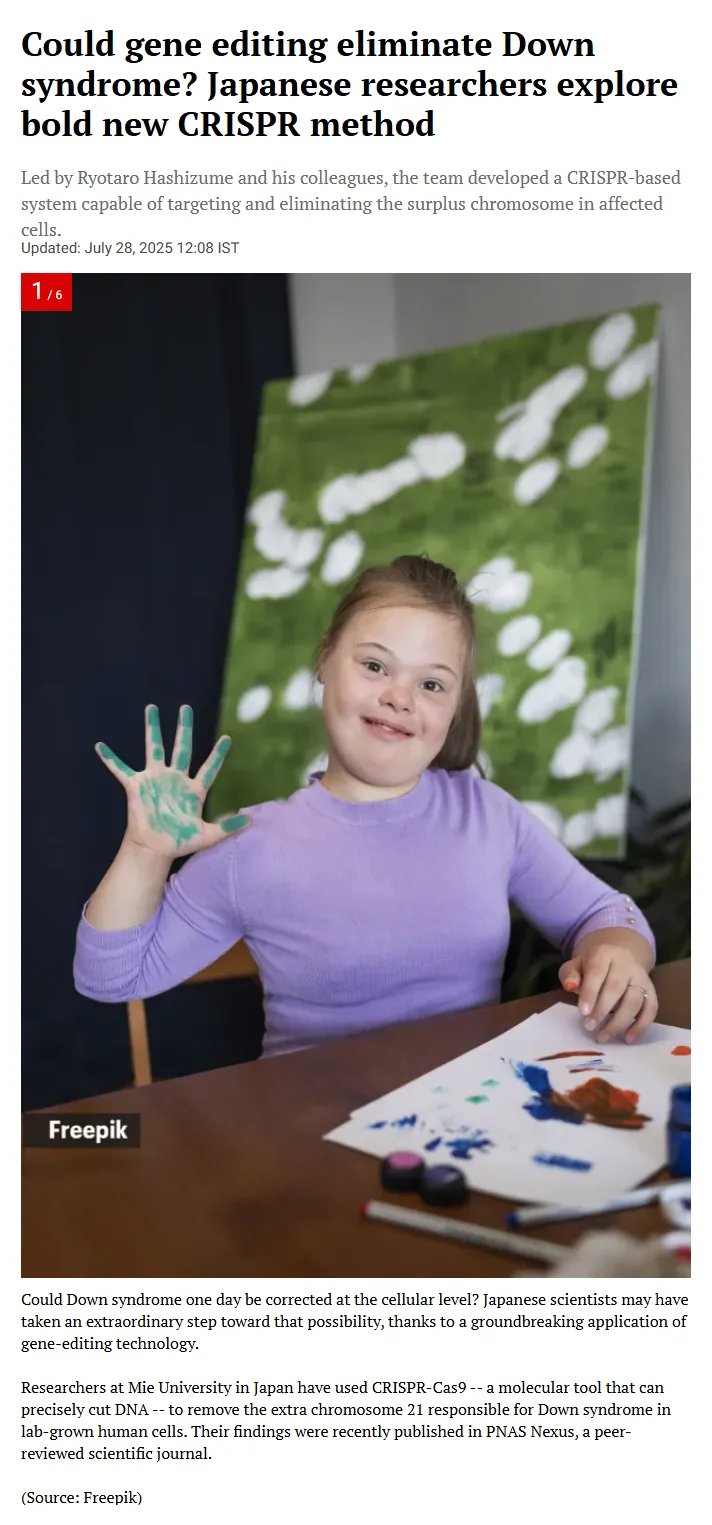
Could Down syndrome one day be corrected at the cellular level? Japanese scientists may have taken an extraordinary step toward that possibility. Researchers at Mie University used CRISPR-Cas9, a molecular tool that can precisely cut DNA, to remove the extra chromosome 21 responsible for Down syndrome in lab-grown human cells. Their findings were published in the peer-reviewed journal PNAS Nexus.
Led by Ryotaro Hashizume and colleagues, the team developed a technique called allele-specific editing, which ensured only the surplus chromosome was removed without disrupting the normal ones. When applied to cells with trisomy 21, the cells began to behave more like typical cells, growing faster and with less biological stress. The research is still at an early stage, and it raises profound questions about whether we could, or even should, attempt to eliminate the root cause of Down syndrome.
The Indian Express turned to Dr Arohi Vardhan, Consultant Child and Adolescent Psychiatrist at Cadabam's Hospitals, for a clinical perspective.
A landmark, and a long road ahead
"The recent scientific feat of using CRISPR technology to remove the extra copy of chromosome 21, the underlying cause of Down syndrome, represents a landmark achievement in genetic research," Dr Vardhan told indianexpress.com. "Medically, it signifies a shift from merely managing the condition to addressing its root cause at the genomic level. As a psychiatrist, I see in this not just the promise of chromosomal correction, but the possibility of reshaping the developmental and cognitive outcomes for individuals affected by the condition."
Translating the breakthrough from the lab to real-world therapies, she cautioned, "is a complex challenge." Precision must be ensured to avoid unintended genetic consequences, and safe, targeted delivery of gene-editing tools to living tissue remains a significant hurdle. Though clinical application is still distant, the significance of the development is unquestionable. It invites us to imagine a future where empathy and innovation work hand in hand, offering meaningful improvements in quality of life for people with neurodevelopmental conditions.
What about embryos?
The Japanese study shows the extra chromosome can be removed in lab-grown cells, but prenatal use is a different matter. "If such editing were ever applied prenatally, it would raise major concerns. Early embryonic cells repair DNA in error-prone ways, risking unintended mutations or chromosomal damage. Edits at this stage are heritable, and even precise changes may cause large deletions or mosaicism. While the science is advancing rapidly, applying it to embryos remains a distant and highly sensitive frontier," Dr Vardhan said.
The ethical questions
Using gene editing to eliminate a condition like Down syndrome raises significant ethical questions. The goal may be to lessen medical or developmental difficulties, but it also forces a deeper conversation about how society values the diversity of human experience. Despite genuine obstacles and differing levels of support, many people with Down syndrome contribute significantly to their families, communities and schools. Their lives are a reminder that a medical diagnosis is not the only way to define quality of life.
"As this technology develops, it must be directed not only by scientific rigour but also by inclusive ethical discourse, one that values human diversity, protects against stigma, and prioritises informed, compassionate decision-making," Dr Vardhan concluded.
Support at Cadabam's Hospitals
Whatever the future of genetic research holds, children and adults with Down syndrome and other neurodevelopmental conditions deserve expert, compassionate care today. Cadabam's Hospitals offers child and adolescent psychiatry and specialised support for intellectual disability, helping families build on every individual's strengths. Our team is here to help.