
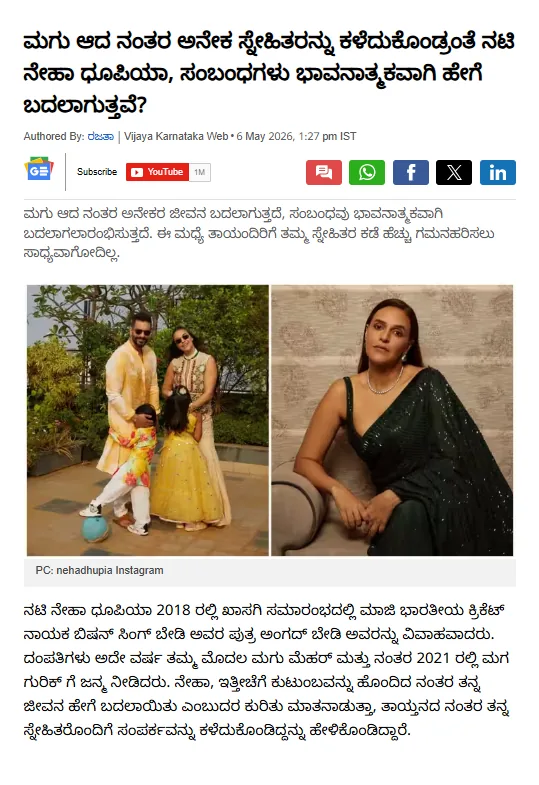
Actor Neha Dhupia married Angad Bedi in 2018, and the couple welcomed daughter Mehr the same year and son Guriq in 2021. Speaking on a podcast hosted by Bharti Singh and Haarsh Limbachiyaa, she shared her three priorities in life, prompting Angad to joke that he sits fifth on her list, after the children, work, parents and home. She also admitted that after having a family she lost touch with many friends. Stepping out for a casual coffee becomes hard when you are looking after children, she said.
For Mother's Day, Vijaya Karnataka asked Neha Cadabam, Senior Psychologist at Cadabam's Mindtalk, why relationships change so profoundly after a child arrives. This summary is translated from the Kannada-language feature.
From a pair to a triangle
Before a baby, a romantic relationship is a two-person system in which emotional energy flows directly back and forth. When a child is born, the system suddenly becomes a triangle, and family systems theory holds that triangles are inherently more complex and emotionally unstable. A mother has a limited amount of "attachment bandwidth", Neha Cadabam explained, and evolution directs most of her emotional, physical and mental energy towards the helpless infant.
The partner's experience
The romantic partner often experiences a sudden withdrawal of emotional intimacy. The mother does not love her partner less; her mental energy is simply monopolised by the baby. If the partner does not understand this as a biological and psychological imperative, it can lead to deep feelings of rejection and resentment.
Identity and 'matrescence'
Psychology has long recognised adolescence as a turbulent period of identity formation. Anthropologist Dana Raphael and later clinical psychologist Dr Aurélie Athan championed the term "matrescence" to describe the equivalent transition into motherhood: turbulent, hormonal and identity-altering. A mother often grieves the loss of her earlier identity, her independence and the simplicity of her former relationships.
Why friendships change
Emotionally, a new mother's friendships often shift dramatically. She may distance herself from friends who do not understand her new psychological reality and naturally gravitate towards other mothers who do.
Support at Cadabam's Hospitals
The transition to parenthood can strain even strong relationships, and feeling lonely or unlike yourself in this season is common. Cadabam's Hospitals offers couples and family therapy and confidential counselling for new parents, including support for postpartum mood changes. Our team is here to help.