
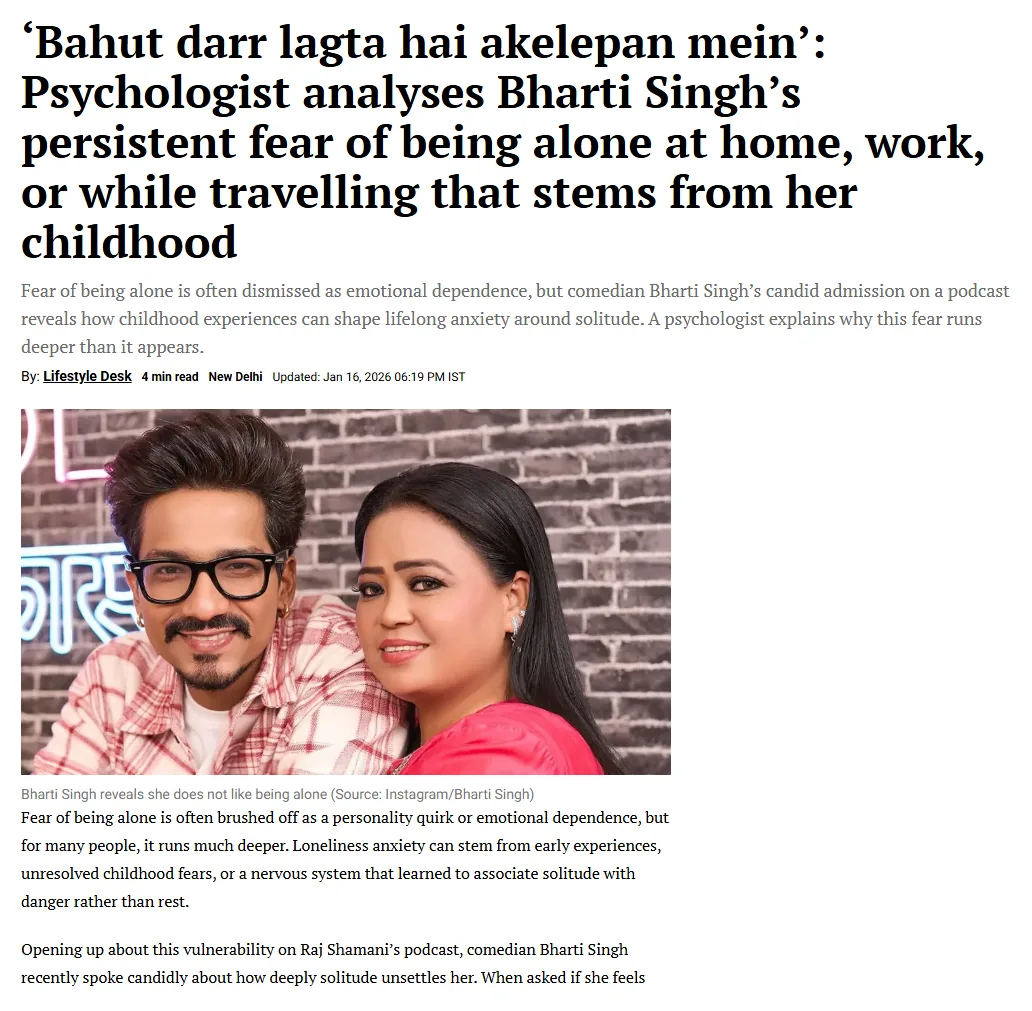
Fear of being alone is often brushed off as a personality quirk or emotional dependence, but for many people it runs much deeper. On Raj Shamani's podcast, comedian Bharti Singh spoke candidly about how solitude unsettles her. "Yes, a lot. I really feel scared of being alone," she admitted. She stays awake until her husband returns at 2 am, cannot live alone at home or while travelling, and has always been in a crowd.
She traced the fear to childhood evenings when she could not reach the light switch and sat outside the dark house on the doorstep while the street lights glowed. The Indian Express asked Neha Cadabam, Senior Psychologist and Executive Director at Cadabam's Hospitals, how such early experiences shape adult anxiety decades later.
The nervous system remembers
"Early childhood fears are rarely about darkness or being alone in a literal sense. They are usually about safety and attachment," Neha Cadabam told indianexpress.com. "When a child repeatedly experiences fear without adequate emotional reassurance, the nervous system learns to associate solitude with danger."
That learning happens at a visceral level, not a cognitive one. "Even decades later, the body can react to being alone with the same heightened alertness, racing thoughts, or unease, even when the adult mind knows there is no real threat. Essentially, the nervous system remembers what the mind has long forgotten."
Discomfort or a deeper fear?
Feeling uneasy or bored while alone is a normal human experience. A deeper fear of loneliness becomes a concern "when solitude triggers intense anxiety, panic, or a sense of emotional collapse," she said. People may constantly seek noise, company or distraction, avoid being alone at home, struggle with solo travel, or feel distressed when separated from familiar people.
"The key difference is impairment. When the fear starts shaping daily choices, relationships, or self-worth, it moves beyond discomfort into an anxiety pattern that deserves attention and care."
Retraining the nervous system to feel safe
The goal is not to force solitude abruptly but to build safety in small, compassionate steps. "This can include spending short, intentional moments alone while engaging in grounding activities like listening to music, journaling, or mindful breathing. Creating predictability and comfort in the environment also helps the nervous system relax."
Most importantly, adults need to acknowledge the fear without judging it. "Therapy can play a key role by helping individuals process the original emotional memories that shaped the fear, allowing the body to slowly learn that being alone no longer equals being unsafe."
Support at Cadabam's Hospitals
If being alone triggers panic rather than peace, the pattern can be unlearned. Cadabam's Hospitals offers psychotherapy and specialist care for anxiety, helping you process the memories underneath the fear and build a calmer relationship with solitude. Our team is here to help.