
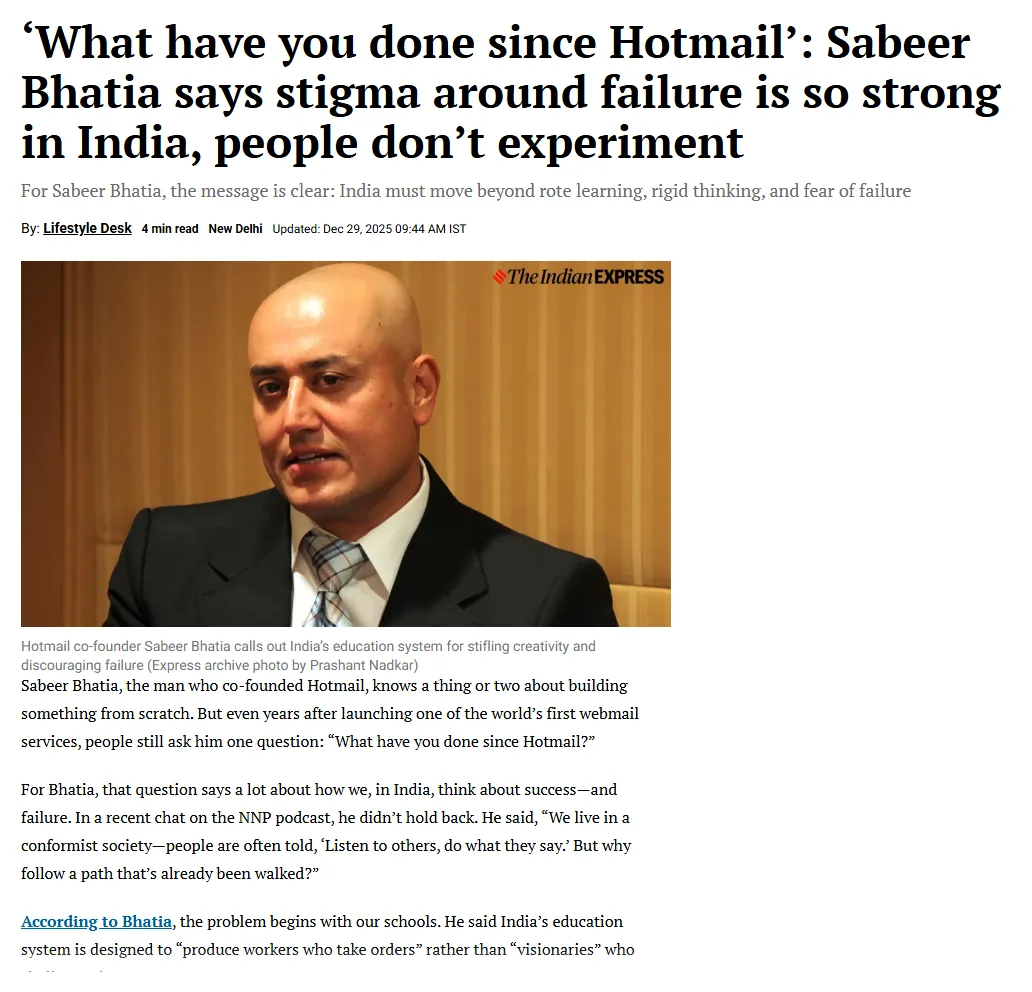
Sabeer Bhatia, the man who co-founded Hotmail, knows a thing or two about building something from scratch. Yet years later, people still ask him one question: "What have you done since Hotmail?" For Bhatia, that question says a lot about how India thinks about success and failure.
Speaking on the NNP podcast, he argued that India's education system is designed to "produce workers who take orders" rather than visionaries, that children are punished for errors instead of being encouraged to think, and that a deep discomfort with failure holds back innovation. "Unless India stops confusing blind obedience with real intelligence, it will continue to lose talented minds," he said. Many students, he added, choose medicine or engineering not out of passion but because society tells them to.
Failure can be scary to come to terms with. The Indian Express asked Neha Cadabam, Senior Psychologist and Executive Director at Cadabam's Hospitals, what repeated setbacks do to a person and how to recover.
What repeated failure does to the mind
Repeated setbacks can have a profound and lasting impact on mental and emotional well-being, Neha Cadabam explained. "Research has shown that chronic stress, a common consequence of repeated failures, can lead to a cascade of negative effects. Elevated cortisol levels, the primary stress hormone, can disrupt sleep patterns, impair cognitive function, and even compromise the immune system."
Failure can also erode self-esteem and confidence, leading to a negative self-perception and a higher risk of depression and anxiety. "The constant pressure to perform and the emotional toll of repeated setbacks can also lead to burnout, a state of emotional, physical, and mental exhaustion," she said, describing burnout as marked by cynicism, detachment and a reduced sense of personal accomplishment.
How to bounce back
Recovering from repeated failures takes practical strategies and a resilient mindset. "One effective approach is reframing failure as feedback, viewing setbacks as opportunities for learning and growth. This shift in perspective can help individuals maintain motivation and avoid a downward spiral of negativity," she said.
She also recommended positive affirmations, journaling, setting realistic standards for oneself and, most importantly, self-compassion, so that the fear of failure does not stop a person from getting on with their life.
Support at Cadabam's Hospitals
If setbacks have left you exhausted, anxious or doubting yourself, support can help you rebuild. Cadabam's Hospitals offers counselling and care for stress, burnout and depression, helping you turn failure into feedback. Our team is here to help.