
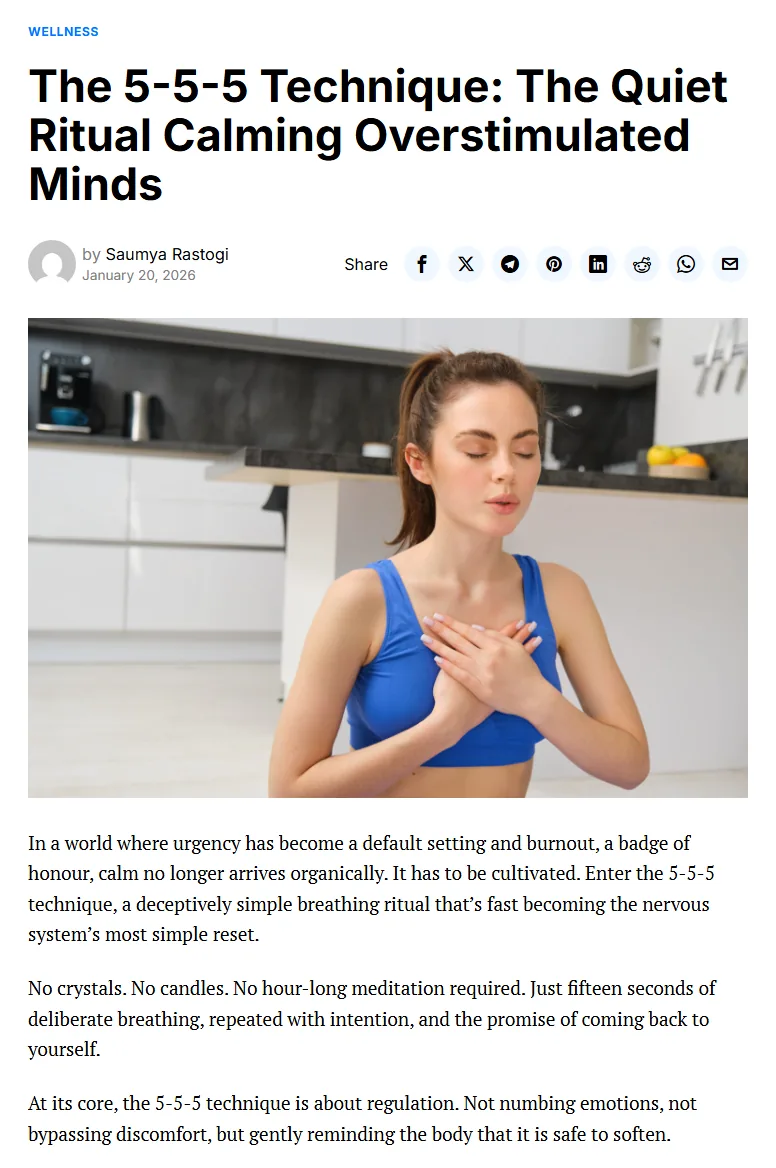
In a world where urgency has become the default setting and burnout a badge of honour, calm no longer arrives on its own. Enter the 5-5-5 technique, a deceptively simple breathing ritual that The Gourmet Edit describes as the nervous system's most accessible reset: no crystals, no candles, no hour-long meditation, just fifteen seconds of deliberate breathing, repeated with intention.
What the 5-5-5 technique is
The technique is a simple regulation tool designed to interrupt stress, anxiety or emotional overwhelm in the moment. Its power lies in the structure as much as the breath: when the mind feels flooded, it looks for something familiar and predictable, and the steady rhythm of a five-count inhale, hold and exhale provides containment and creates safety.
According to Neha Cadabam, Senior Psychologist at Cadabams Mindtalk, the technique is rooted in polyvagal theory, helping the body move out of a fight-or-flight response and back into a parasympathetic, rest-and-restore state. Some clinicians use a sensory variation, naming five things you can see, hear and feel, but the principle is the same: pulling the brain out of threat mode and anchoring it in the present.
Why it works
We have all tried to think our way out of anxiety and failed. That is because anxiety does not start in the mind; it starts in the body. The slow inhalation signals a shift away from urgency, the brief hold teaches the system that stillness is tolerable, and the extended exhale activates the parasympathetic nervous system, lowering stress hormones and allowing clarity to return.
Paced breathing stimulates the vagus nerve, Neha Cadabam added, improving heart rate variability, a key marker of emotional resilience. Research in journals such as Frontiers in Psychology shows that structured breathing can reduce cortisol and muscle tension, often before the mind even realises it is calming down. In simpler terms: the body settles first, the mind follows.
"It's especially helpful for people who struggle with 'thinking their way out of anxiety,'" she said. "Somatic regulation often comes before cognitive clarity."
What it cannot do
Like every wellness tool, the 5-5-5 technique is not a cure-all. It works best for mild to moderate emotional overwhelm. For chronic anxiety, trauma or panic disorders, breathing techniques alone are not enough. Some people find breath-holding uncomfortable at first and may need to shorten the hold or focus only on a slow exhale. There is also a risk of over-reliance: used as a quick fix without addressing underlying patterns, it brings temporary relief without long-term change. Breathing exercises are most effective when paired with deeper therapeutic work such as CBT, trauma-informed therapy or mindfulness-based interventions.
Support at Cadabam's Hospitals
A breathing reset can carry you through a hard moment. If anxiety, panic or chronic stress keep returning, Cadabam's Hospitals offers evidence-based therapy that addresses the patterns underneath. Our team is here to help.