
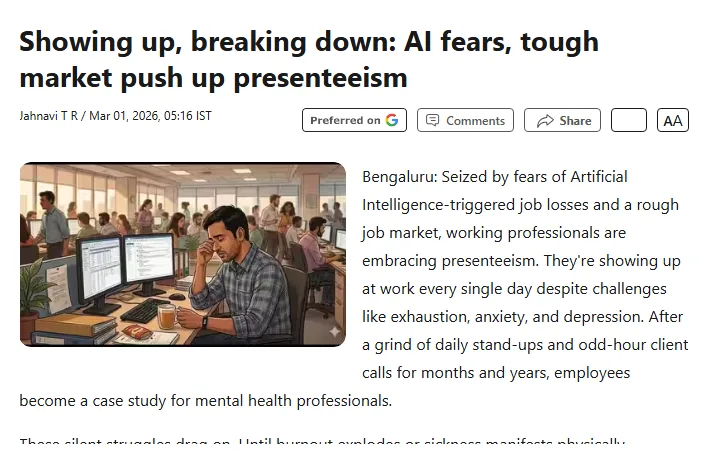
Seized by fears of AI-triggered job losses and a rough job market, Bengaluru's working professionals are embracing presenteeism, The Times of India reported. They show up at work every single day despite exhaustion, anxiety and depression. After a grind of daily stand-ups and odd-hour client calls stretching over months and years, their silent struggles drag on until burnout explodes or sickness manifests physically.
Clinicians quoted in the report described a rise in employees who function outwardly while struggling internally, masking symptoms to meet expectations in high-pressure environments where productivity is valued above well-being.
How mental exhaustion shows up at work
Neha Cadabam, Senior Psychologist and Executive Director at Cadabam's Hospitals, broke down how it affects productivity. "The presentation depends on the job. For roles needing creative thinking or strategy, mental health issues definitely take a toll. If it is a monotonous task, it gets done mindlessly. Quality might drop, coffee breaks might increase, or a person might sit in front of a computer without truly investing hours."
Because there is no visible physical abnormality, other clinicians noted, people with depression or anxiety come across as "okay" while their communication, concentration, judgement and overall capacity quietly deteriorate.
Why mental health leave goes unclaimed
Workplaces have evolved, with sensitive managers, company-sponsored counselling and, in some organisations, dedicated mental health leave. Yet employees still baulk at claiming it.
"If an employee takes a mental health day off and returns the next day, a manager might ask, 'You took a mental day off, what happened?' Those kinds of questions can feel intrusive or stigmatising. Employees worry about what people may think of them," Neha Cadabam explained.
Experts called for greater normalisation: formal mental health leave, flexible hours, realistic workloads, visible leadership support, and training for managers to recognise burnout. Gen Z, the report noted, appears bolder than people in their 30s and 40s, actively using counselling and employee-assistance programmes and being upfront with line managers when they are not well.
Support at Cadabam's Hospitals
If you are showing up every day but running on empty, help before burnout becomes illness. Cadabam's Hospitals offers confidential counselling and evidence-based care for work-related stress, anxiety and depression, with flexible outpatient support for working professionals. Our team is here to help.