
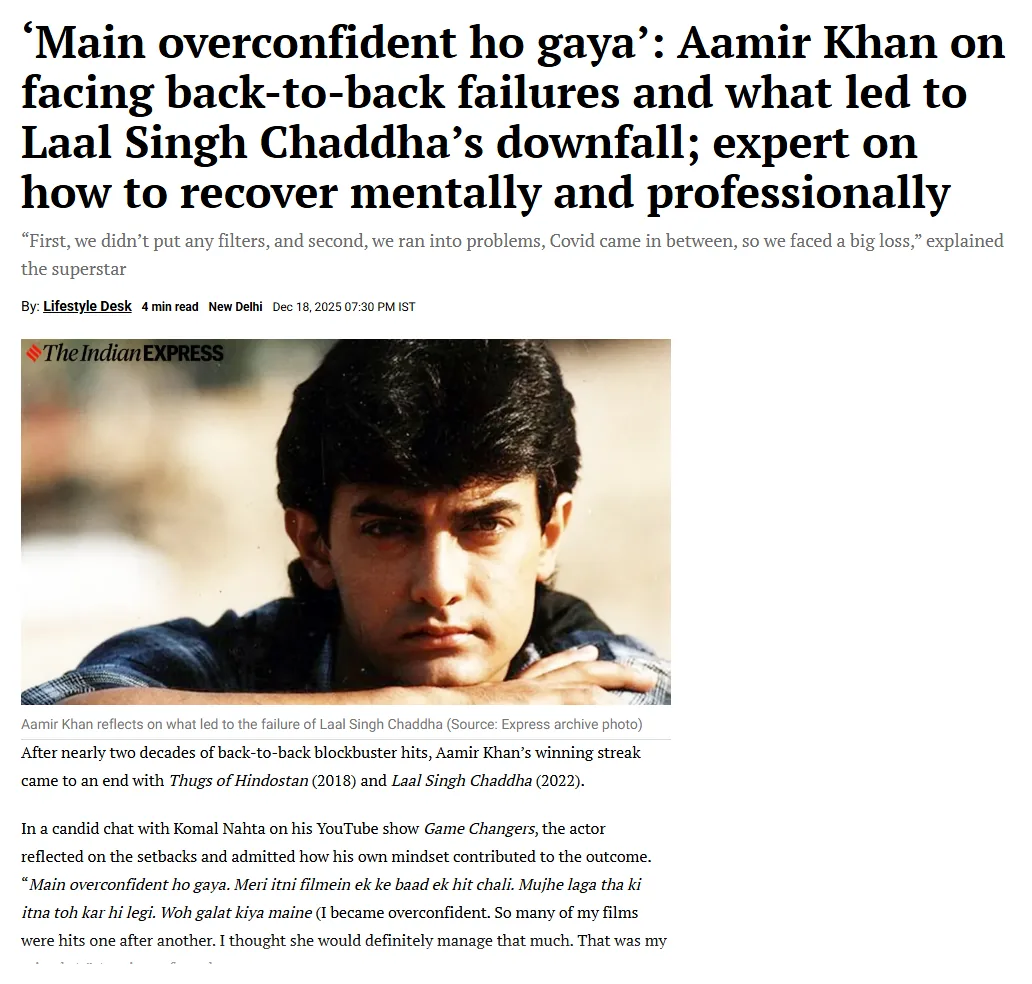
After nearly two decades of back-to-back blockbusters, Aamir Khan's winning streak ended with Thugs of Hindostan and Laal Singh Chaddha. In a candid chat on Komal Nahta's show Game Changers, the actor admitted how his own mindset contributed. "I became overconfident. So many of my films were hits one after another. I thought this one would definitely manage that much. That was my mistake."
Aamir explained that he had always applied an "economic filter" as a producer: a film should never cause a loss, even if it did not break records. With Laal Singh Chaddha, that filter was set aside. A film that should have cost Rs 50 to 60 crore ended up costing Rs 200 crore, compounded by pandemic delays and his decision to keep paying workers through the shutdown.
His reflections are about the film industry, but the lessons about overconfidence, miscalculated risk and ignored safeguards apply to careers, businesses and personal decisions. The Indian Express asked Neha Cadabam, Senior Psychologist and Executive Director at Cadabam's Hospitals, to explain the psychology.
How success clouds judgement
"Repeated success often creates a sense of invulnerability," Neha Cadabam told indianexpress.com. "Psychologically, it can trigger what we call the 'illusion of control,' where individuals begin to overestimate their ability to influence outcomes. There is also a tendency to selectively remember wins while minimising past failures, which reinforces inflated confidence. This state of mind clouds judgement because decision-making shifts from careful evaluation to assumptions of automatic success."
Safeguards against costly missteps
One of the most effective filters is structured reflection. "Before committing to a decision, individuals should pause and deliberately consider potential downsides as carefully as the upsides. Building a habit of seeking diverse perspectives also acts as a safeguard, since external viewpoints can highlight blind spots that personal confidence may overlook," she explained.
Recovering after a major setback
Acknowledging a mistake without self-criticism allows a person to shift from shame to learning. "Psychologically, it helps to reframe failure as feedback rather than as a reflection of personal inadequacy. On a practical level, analysing what went wrong and identifying the specific role overconfidence played is critical for preventing recurrence. Building resilience also requires re-engaging with small, achievable goals to restore confidence in one's abilities," she concluded.
Support at Cadabam's Hospitals
A major professional setback can shake confidence, sleep and mood for months. Cadabam's Hospitals offers counselling and support for stress, burnout and low mood, helping you rebuild judgement and confidence one achievable goal at a time. Our team is here to help.