
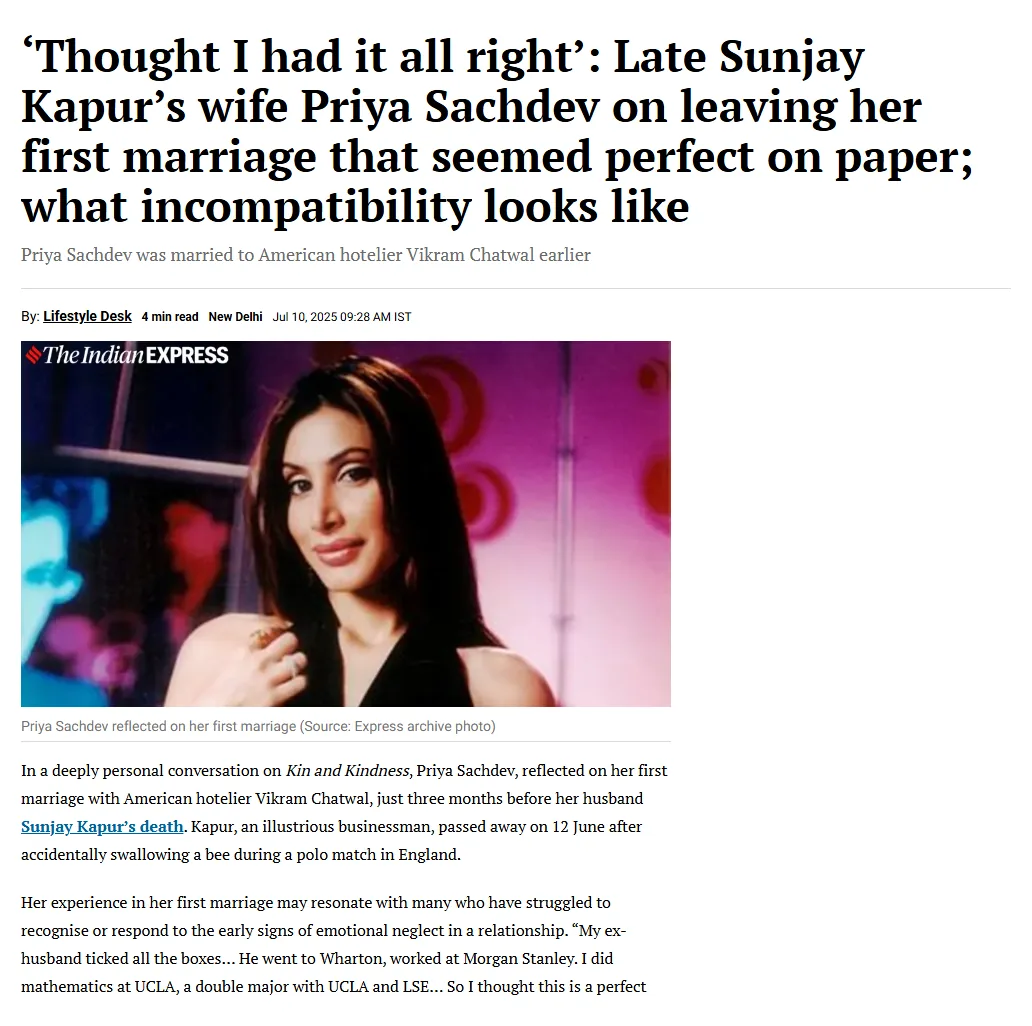
In a candid conversation on the podcast Kin and Kindness, recorded three months before her husband Sunjay Kapur's death, Priya Sachdev reflected on her first marriage to American hotelier Vikram Chatwal. On paper, she said, it was a perfect match. "My ex-husband ticked all the boxes… I thought I had it all right… but I guess I chose wrong."
She began sensing something was wrong 15 to 20 weeks into her pregnancy, yet kept trying to make the marriage work, finally leaving five years later for her own peace and her daughter's. Her story, The Indian Express noted, may resonate with many who struggle to recognise or respond to the early signs of emotional neglect in a relationship. The paper turned to Neha Cadabam, Senior Psychologist and Executive Director at Cadabam's Hospitals, for a clinical perspective.
The red flags people overlook
"When a relationship looks ideal externally, it is easy to ignore subtle emotional red flags," Neha Cadabam told indianexpress.com. "One common sign is a persistent feeling of being emotionally drained after interactions with a partner. This can be misinterpreted as stress or adjustment issues, but it often signals an imbalance in emotional reciprocity."
"Another red flag is when someone begins to minimise their own needs or consistently rationalises behaviour that makes them uncomfortable. Also, when a partner avoids accountability or makes you question your memory or feelings, even subtly, it can undermine emotional safety."
People often dismiss these feelings, she added, "in the hope that things will improve or because the relationship appears stable on the outside." But emotional safety, consistent respect and mutual support matter from the very beginning, even when there is no overt conflict.
Adjustment struggles or long-term incompatibility?
Adjustment struggles are expected in any long-term relationship. "They usually arise from situational stress, lifestyle differences, or communication gaps and tend to improve with time, mutual effort, and open conversation. Both partners remain emotionally available and express a shared willingness to grow together," she said.
Emotional neglect and incompatibility, in contrast, are "more persistent and feel one-sided." The signs include a lack of emotional responsiveness, repeated dismissal of concerns, or feeling lonely even when together. When one partner consistently avoids meaningful connection, or emotional needs are met with silence or criticism, it points to more than temporary friction.
"Long-term incompatibility often shows up in values, emotional capacity, or life goals that feel fundamentally mismatched. Unlike temporary issues, these do not resolve with better communication alone and tend to leave one or both partners feeling unseen or unheard over time," she explained.
Support at Cadabam's Hospitals
Recognising emotional neglect is the first step, and you do not have to work through it alone. Cadabam's Hospitals offers confidential relationship and couples counselling as well as individual therapy for the anxiety, low self-worth and loneliness that unhealthy relationships can leave behind. If any of this feels familiar, our team is here to help.