
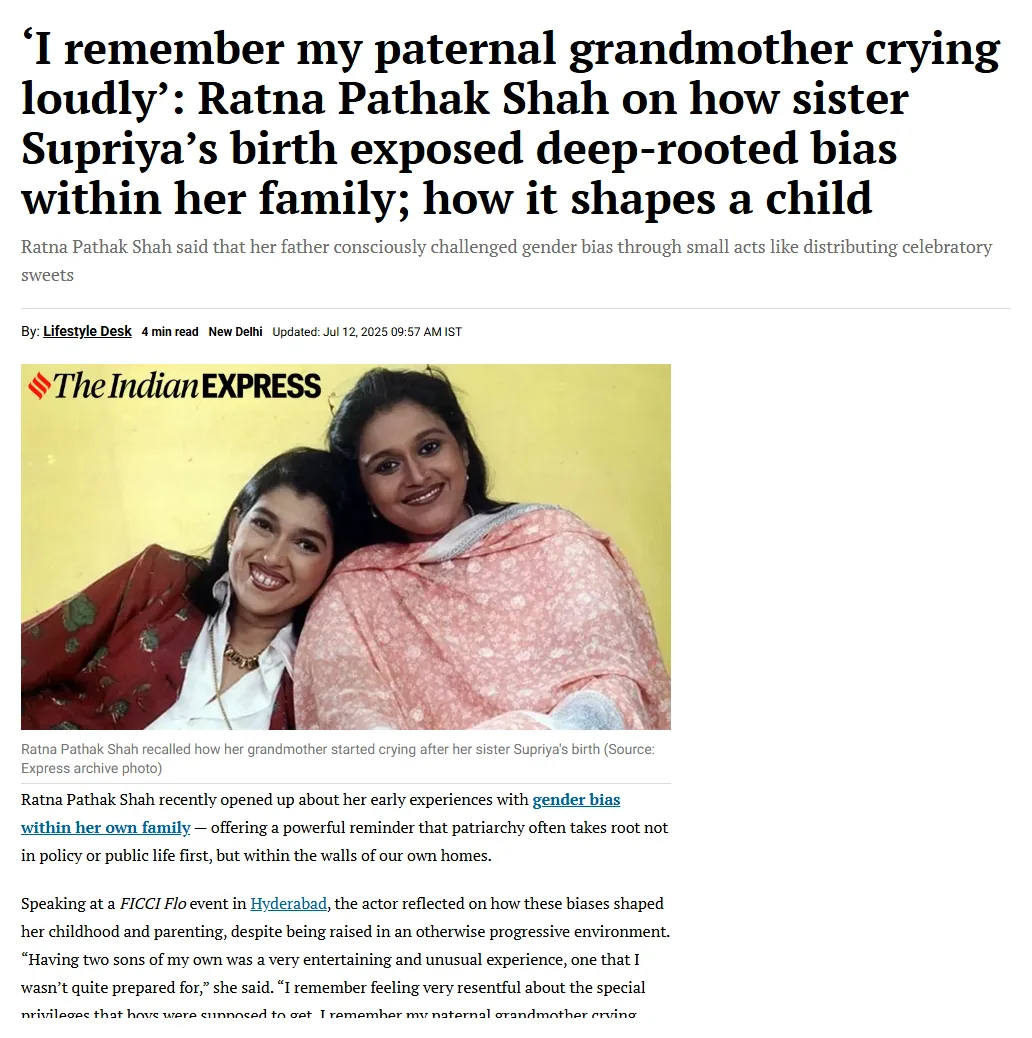
Ratna Pathak Shah recently opened up about her early experiences with gender bias within her own family, a powerful reminder that patriarchy often takes root not in policy or public life first, but within the walls of our own homes.
Speaking at a FICCI Flo event in Hyderabad, the actor reflected on how these biases shaped her childhood and parenting, despite being raised in an otherwise progressive environment. "I remember feeling very resentful about the special privileges that boys were supposed to get. I remember my paternal grandmother crying loudly when my sister (Supriya) was born. 'Haye haye doosri beti aagayi (Oh no, another girl).' And I remember feeling terrible about that."
Her father responded with defiance, distributing the sweets traditionally reserved for the birth of a boy. "It was like an affirmation of acceptance," she said. "Why should a girl's existence be so unwelcome? I realised that it starts in the families."
The Indian Express turned to Neha Cadabam, Senior Psychologist and Executive Director at Cadabam's Hospitals, to understand what such moments do to a child.
How early messages shape self-worth
"Early childhood is a formative stage when children absorb emotional cues from the environment, especially trusted adults," Neha Cadabam told indianexpress.com. "When a child witnesses or hears expressions of disappointment tied to gender, it can leave a lasting imprint on their sense of self-worth and identity. Even if those messages aren't directed at them personally, they shape how the child understands their value in the world."
Such moments also influence how children perceive gender roles and expectations. Girls may internalise a sense of lesser value, while boys may unconsciously absorb a sense of privilege. These messages rarely arrive in words alone. They are felt in tone, behaviour and reactions, and become part of the emotional language the child grows up with.
The power of a symbolic gesture
Symbolic gestures that challenge prevailing norms, like Ratna's father distributing sweets, can be remarkably powerful within family systems. They stand out precisely because they contrast with what is expected, and over time they begin to reshape the family's narrative.
"Such gestures may seem small on the surface, but they spark conversations, shift perspectives, and encourage others in the family to reflect. They also show children that there are choices available. Traditions can be questioned, and values can evolve. When done consistently, these acts create a more inclusive and respectful emotional environment," she noted.
Why patriarchy persists in educated homes
Patriarchy, she explained, is "deeply embedded in cultural memory," passed down quietly through generational practice rather than active intent. "Even in educated households, certain gendered expectations, like who carries forward the family name or who deserves more freedom, can continue under the surface of modernity."
Unlearning that conditioning takes more than awareness. It needs conscious, ongoing reflection: introducing equitable practices, encouraging both boys and girls to express a full range of emotions, and revisiting traditional roles together as a family.
Support at Cadabam's Hospitals
The messages a child absorbs at home shape their emotional health for years to come. Cadabam's Hospitals offers child and adolescent mental health care and family therapy that help parents recognise inherited patterns and build a home where every child feels valued. If your family could use that support, our team is here to help.