
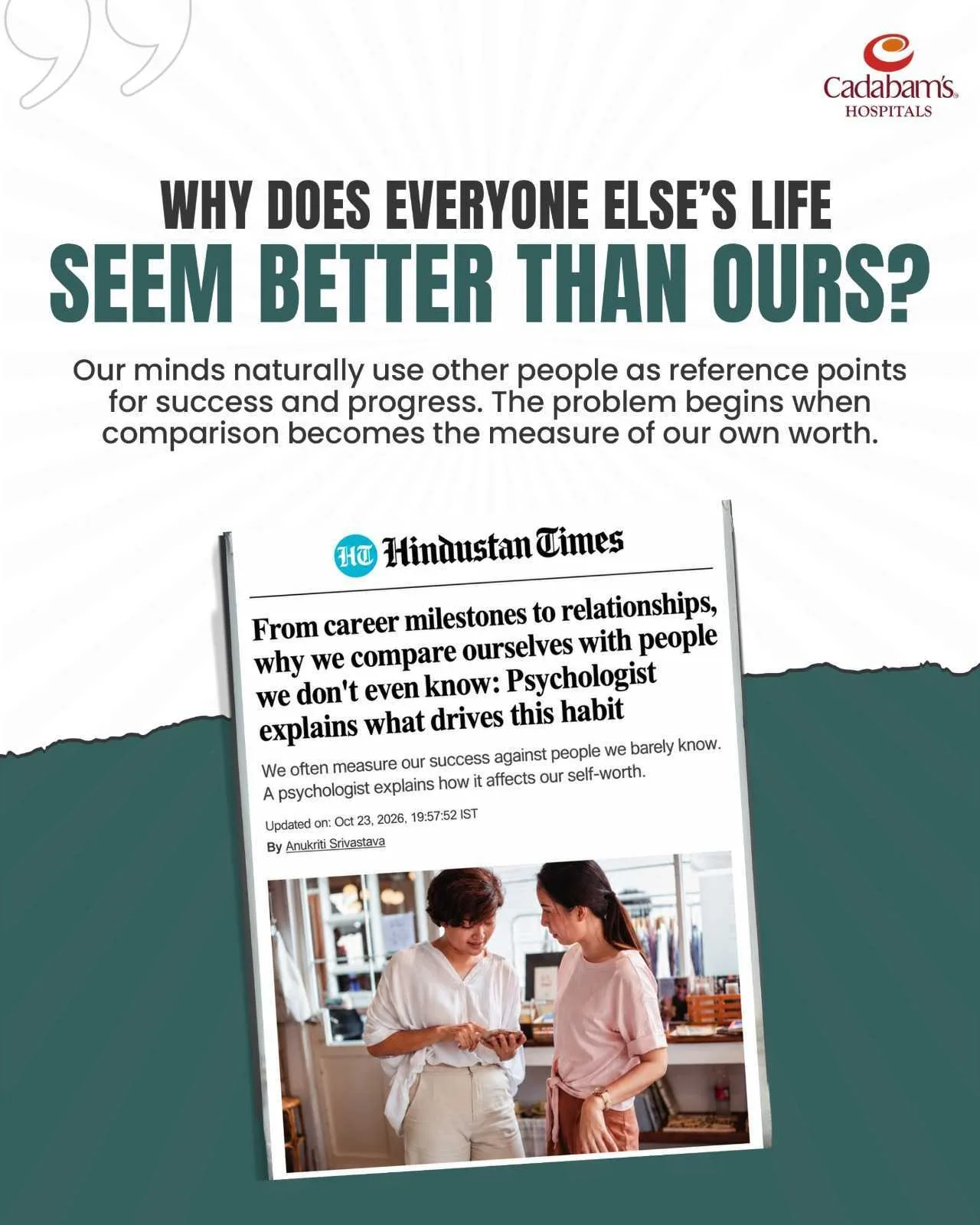
"The grass is always greener on the other side" captures how often we hold our own lives up against what we see of other people's, from career milestones to relationships. Hindustan Times explored what drives this habit on 23 October 2026, in an interview with Dr. Aparna Rani, Clinical Psychologist at Cadabam's Hospitals.
Why we compare our lives with others
According to Dr. Rani, we compare ourselves with people we do not even know because the human brain naturally uses other people as reference points to judge our own progress, achievements and sense of worth. Psychologists call this social comparison. We often decide whether we are doing well by looking at how others are doing, particularly in career, relationships, appearance and lifestyle.
The problem begins when we compare our everyday reality with someone else's carefully selected highlights, without seeing the full context of their lives.
How social media intensifies it
"Social media intensifies this tendency because we are constantly exposed to curated images of success, happiness, financial security and physical appearance," Dr. Rani told the publication. Repeated exposure to these images can lead the brain to treat them as a picture of what is normal or expected, even when they are far from representative of reality. That can leave us feeling we are falling behind, even when our own lives are progressing meaningfully.
What drives constant comparison
Dr. Rani noted that comparison becomes more frequent when a person is going through uncertainty, low self-esteem or dissatisfaction in a particular area of life. Someone unsure about their career, for example, may become especially sensitive to other people's achievements. In such moments, comparison is not always about wanting what another person has. It can reflect an underlying need for reassurance that we are doing enough, or that we are on the right path.
Comparing in a healthier way
"It is important to understand that comparison itself is not inherently unhealthy. It can motivate us to learn, improve and set goals," said Dr. Rani. It becomes harmful when other people's lives turn into the main measure of our own worth.
A healthier approach is to notice when comparison is affecting our mood, ask whether we are comparing ourselves with a realistic picture, and bring our attention back to our own progress, priorities and circumstances. We may not be able to stop the mind from comparing, but we can learn not to treat every comparison as an accurate judgement of our lives.
If constant comparison is wearing down your self-esteem or feeding anxiety and low mood, Cadabam's Hospitals' psychologists and psychiatrists can help. Call +91 97414 76476 for a confidential consultation.