
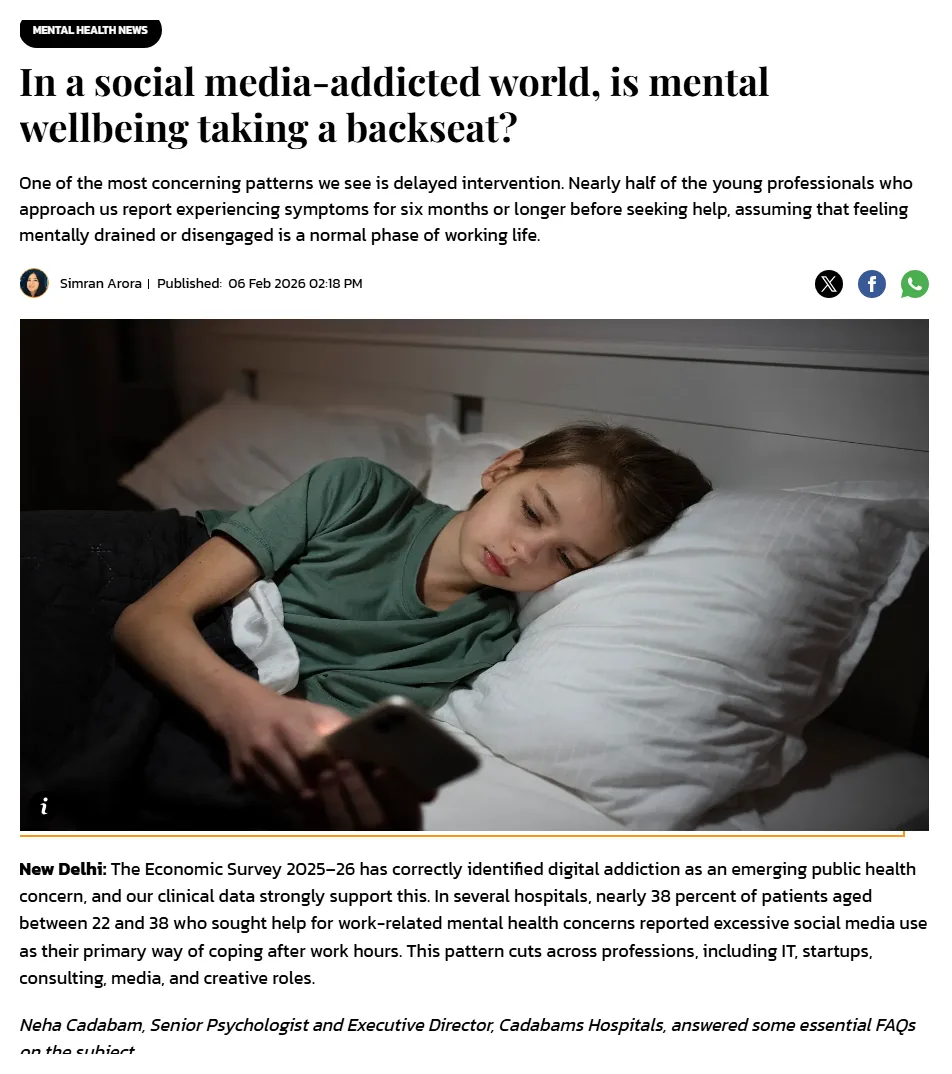
The Economic Survey 2025-26 has identified digital addiction as an emerging public health concern, and clinical data from Cadabam's Hospitals strongly supports it. Across several hospitals, nearly 38% of patients aged 22 to 38 who sought help for work-related mental health concerns reported excessive social media use as their primary way of coping after work hours, a pattern that cuts across IT, startups, consulting, media and creative roles. Neha Cadabam, Senior Psychologist and Executive Director at Cadabam's Hospitals, answered News9's questions on what the data shows.
Social media is replacing emotional recovery
What clinicians are seeing is a shift in how young adults try to regulate stress. Instead of rest, reflection or disengagement, many turn to prolonged digital engagement. In Cadabam's clinical assessments, over 60% of working professionals in this age group report spending two to three hours or more on social media late at night, believing it helps them decompress. In reality, it keeps the brain in a heightened state of alertness rather than allowing psychological recovery.
Why the problem goes unnoticed
The trend is widely misunderstood because social media use is normalised and often encouraged. But the brain does not recognise scrolling as rest. Constant exposure to content, notifications and social comparison prevents the nervous system from settling. As the Economic Survey highlights, this has direct consequences for cognitive performance, emotional regulation and overall mental health, even when people appear outwardly functional.
Delayed help-seeking and masked symptoms
One of the most concerning patterns is delayed intervention. Nearly half of the young professionals who approach Cadabam's report experiencing symptoms for six months or longer before seeking help, assuming that feeling mentally drained or disengaged is a normal phase of working life. By the time they reach clinical care, symptoms are often more entrenched and recovery requires longer-term intervention.
What needs to change
This is no longer just a lifestyle issue. It is a mental health and public health concern. Digital engagement cannot replace genuine psychological downtime. The Survey's observations underline the need for awareness, early identification of symptoms, healthier digital boundaries and structured recovery practices. Without them, we risk normalising a pattern that quietly erodes the mental well-being of an entire working-age population.
Support at Cadabam's Hospitals
If late-night scrolling has become the only way you switch off, and you still wake up drained, it may be time to talk to someone. Cadabam's Hospitals offers confidential counselling and evidence-based care for work-related stress and burnout, helping young professionals recover properly. Our team is here to help.