
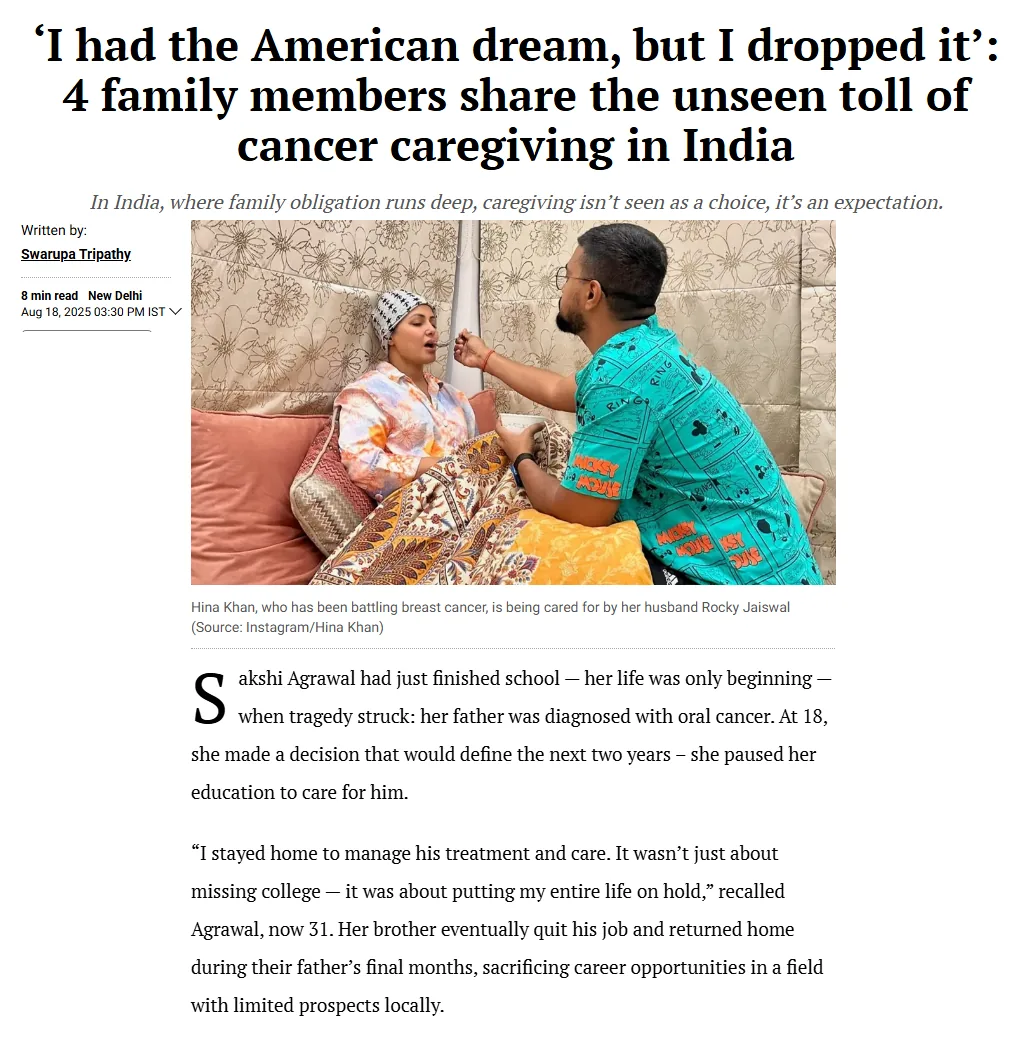
Sakshi Agrawal had just finished school when her father was diagnosed with oral cancer. At 18, she paused her education to manage his treatment and care, putting her entire life on hold for two years. Her brother later quit his job and returned home for their father's final months. Across India, The Indian Express reported, millions quietly shoulder the exhausting responsibility of caring for loved ones with cancer, often becoming invisible casualties of a disease that demands everything from everyone it touches.
The weight of duty
In India, where family obligation runs deep, caregiving is rarely seen as a choice. It is an expectation. Saumya Sharma, who cared for her father until his death in 2021 and now supports her mother through breast cancer treatment, described it in one word: "bone-crushing exhaustion", followed closely by resentment at a situation where nothing you do is ever enough. She gave up an H-1B visa application and a career in Boston to return home. "I dropped the American dream. I don't regret it."
For Pavithra Sekar, caring for her mother with stage 3 breast cancer means living in a constant state of vigilance, no peaceful nights, medicine bills of Rs 20,000 a month, a six-hour daily commute to afford it, and marriage proposals turned down by families afraid she will get cancer too. A 2022 study cited in the report found that two in five caregivers of cancer patients screen positive for depression.
Why caregivers suffer in silence
Ayushi Mathur, who has cared for her mother with metastatic breast cancer since 2018, put the cultural burden plainly: "Sacrifices and hard work are seen as your duty. You're just expected to do it."
Neha Cadabam, Senior Psychologist at Cadabam's Hospitals, told The Indian Express that this mindset leaves little space for caregivers to acknowledge their own pain. "Many internalise their distress, fearing it would be seen as selfish or inappropriate," she said.
The trauma can linger long after the crisis ends. "Many caregivers experience flashbacks, anxiety, or a sense of purposelessness once their role ends," she added. Sharma's experience bears this out: she fell into depression three years after her father's death. "During the illness, you live in survival mode."
A system that does not see them
Oncologists quoted in the report confirmed that caregivers carry the emotional weight of a diagnosis as heavily as the patient, with far fewer outlets to express it, and that caregiver exhaustion can compromise medication accuracy and follow-up care. Yet India's healthcare system remains deeply focused on the patient, with almost no formal support for the person beside the bed. Experts called for routine mental health check-ins, on-site counsellors, distress assessment tools and patient navigation services. With over 1.4 million new cancer cases diagnosed in India every year, the army of invisible caregivers keeps growing.
Support at Cadabam's Hospitals
If you are caring for someone with a serious illness, your exhaustion, grief and anxiety are real and deserve care of their own. Cadabam's Hospitals offers confidential counselling and treatment for caregiver depression and anxiety, including support for the delayed grief and trauma that can surface once the caregiving role ends. Our team is here to help.