
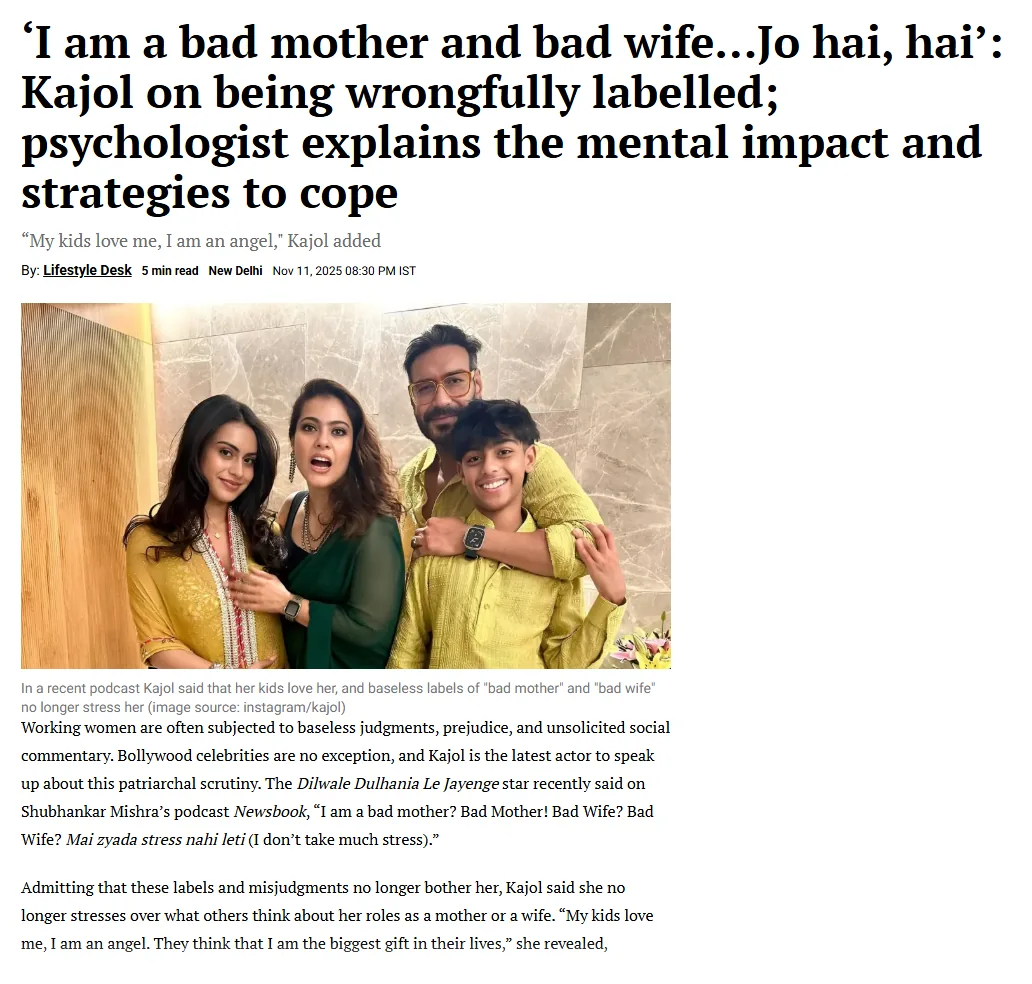
Working women are often subjected to baseless judgements and unsolicited social commentary, and Bollywood celebrities are no exception. Speaking on Shubhankar Mishra's podcast Newsbook, Kajol addressed the labels head-on: "I am a bad mother? Bad Mother! Bad Wife? Bad Wife? I don't take much stress." The labels no longer bother her, she said. "My kids love me, I am an angel. They think that I am the biggest gift in their lives."
Taking a cue from her remarks, The Indian Express reached out to Aparna Rani, Clinical Psychologist at Cadabam's Hospitals, to understand how such labels affect a person and how best to deal with them.
How labels corrode self-identity
Internalising labels such as "you're a bad mother" or "you're a bad wife" can have a profoundly corrosive effect on mental health and self-perception. "This involves integrating external judgments into one's core self-concept, a psychological structure known as a self-schema," she explained. "Their brain can begin to treat these statements as data points about their identity."
Repeated exposure to negative labels, especially from significant others, can trigger cognitive dissonance, where a person's positive self-view clashes with the label. To resolve the conflict, they may subconsciously adjust their self-schema to match the negativity. Confirmation bias amplifies the effect: "A mother who's been called 'bad' might fixate on the one time she lost her temper, while ignoring countless times she was patient and nurturing." Over time this can lead to depression, guilt, anhedonia, anxiety, low self-esteem and identity disturbance.
How labels spill into relationships
Negative labels inevitably affect relationships. "People may withdraw from social situations, become hypersensitive to perceived criticism, and engage in excessive people-pleasing," she said. Even a neutral comment from a partner might be read as an accusation of incompetence, prompting defensive or irritable responses that push loved ones away. A mother who feels inadequate may become overly permissive out of guilt or overly strict out of fear, confusing children and straining partnerships.
"The partner or child may feel like they are walking on eggshells, unable to communicate openly for fear of triggering a negative reaction. This erodes trust and emotional intimacy, ironically reinforcing the individual's belief that they are failing in their relationships," she cautioned.
Strategies to stop internalising labels
"Cognitive reframing is key. Recognise the thought as just a thought, challenge the evidence, and replace it with a balanced statement. For example, 'I'm a human mother doing my best. I make mistakes, but I always love my children and try to grow.' Act like a detective: write down times you were caring or supportive to counter the negative label."
She also emphasised self-compassion through mindful awareness, common humanity and self-kindness, which research links to lower anxiety and depression. Other strategies include setting healthy boundaries, starting small, curating supportive social circles while limiting contact with consistently critical people, and seeking professional help, with therapies such as CBT and ACT proven effective for challenging negative self-perceptions and building self-worth.
Support at Cadabam's Hospitals
If criticism from others has started to feel like the truth about who you are, therapy can help you separate the label from the person. Cadabam's Hospitals offers psychotherapy, including CBT and ACT, and confidential counselling for mothers, partners and anyone carrying the weight of unfair judgement. Our team is here to help.