
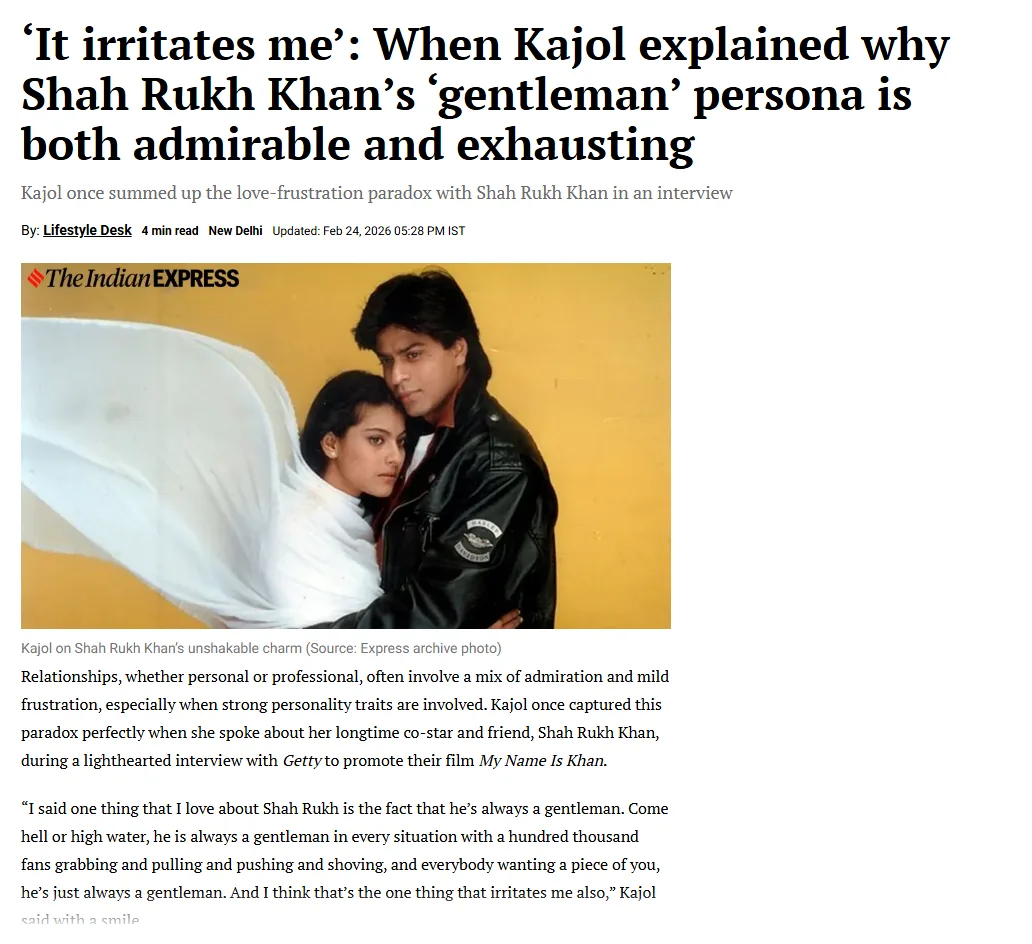
Relationships, personal or professional, often mix admiration with mild frustration, especially when strong personality traits are involved. Kajol captured the paradox while promoting My Name Is Khan with her longtime co-star and friend Shah Rukh Khan. "One thing that I love about Shah Rukh is the fact that he's always a gentleman. Come hell or high water, with a hundred thousand fans grabbing and pulling and pushing, he's just always a gentleman. And I think that's the one thing that irritates me also," she said with a smile.
Her words touch something many of us experience: the tension between respecting someone's qualities and occasionally feeling exhausted by them. The Indian Express asked Neha Cadabam, Senior Psychologist and Executive Director at Cadabam's Hospitals, to explain it.
Why admired traits start to irritate
"It is a fairly common emotional experience in long-term relationships," Neha Cadabam told indianexpress.com. "Traits we admire in others, such as ambition, calmness, or attentiveness, can, over time, come into conflict with our emotional states or needs, depending on the context. For example, someone's unwavering calmness, which once felt grounding, may feel distant or unresponsive in moments when we are seeking more intensity or spontaneity."
The shift usually reflects our own evolving emotional needs rather than a flaw in the other person. In close relationships we also become more aware of patterns, which creates both deeper connection and occasional friction. "The familiarity brings comfort but also heightens sensitivity to certain behaviours."
Does always playing a role lead to burnout?
Consistency of character, whether calm, polite or generous, is a strength in many relationships. But when someone feels compelled to maintain a particular image or emotional posture, it can lead to internal strain, especially if they do not feel free to express other parts of themselves. That does not mean people always feel burdened by their own consistency; for many, such traits reflect deeply held values. The key is whether the behaviour is self-driven or externally driven.
Holding admiration and irritation together
The most helpful approach is "acknowledging that both admiration and irritation can coexist without cancelling each other out." In close relationships it is natural to feel a range of emotions toward someone we deeply care about. Rather than treating irritation as a threat, it can be an opportunity to reflect on what we need in the moment. Open communication without blame lets both people express their perspectives, and it helps to remember the broader picture: the emotional investment, shared experiences and mutual respect that underpin the bond.
Support at Cadabam's Hospitals
If friction with a partner, friend or colleague has started to outweigh the connection, talking it through with a professional can help. Cadabam's Hospitals offers confidential counselling and family therapy for couples and families who want to communicate without blame. Our team is here to help.